


The shift from reactive to predictive infrastructure management is not a future state. It is happening now in organizations that have invested in AIOps-capable SaaS platforms and mature IT infrastructure automation. Here is what it looks like in practice and why it matters for post-migration operations.
Reactive infrastructure management follows a consistent pattern: a workload consumes resources at an unexpected rate, a threshold is breached, an alert fires, a human investigates, a remediation is applied. The time between the resource constraint beginning to develop and the remediation being applied is measured in hours or days. During that time, workloads are degraded or unavailable.
What Predictive Capacity Planning Changes
Predictive capacity planning identifies resource constraints before they affect workloads. By modeling consumption trends from behavioral data, the system projects when a constrained resource will reach a threshold and provides sufficient lead time for remediation.
Nutanix's Intelligent Operations documentation describes the capacity behavior analytics feature as providing runway forecasting at both the cluster level and the individual VM level. At the VM level, the system identifies specific VMs approaching resource constraints and distinguishes between overprovisioned VMs (with unused capacity that can be reclaimed) and constrained VMs (needing additional resources).
The VM Efficiency Categories
Nutanix Intelligent Operations categorizes VMs into four efficiency groups: overprovisioned (too large for the workload, wasting resources), inactive (unused for more than 30 days), constrained (insufficient resources, performance degraded), and bully (consuming a disproportionate share of cluster resources and starving other VMs). These categories are actionable: overprovisioned and inactive VMs are reclamation candidates; constrained and bully VMs are remediation candidates.
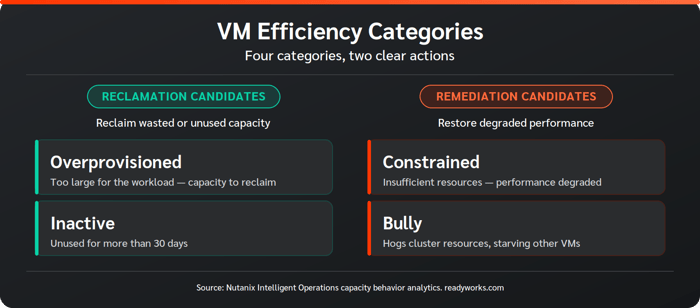
Nutanix Intelligent Operations sorts every VM into four categories that map to two clear actions: reclaim wasted capacity, or remediate degraded performance.
The Post-Migration Operational Dividend
Organizations that migrate to Nutanix (a ReadyWorks technology partner) and invest in Intelligent Operations typically report material reductions in the time their teams spend on reactive troubleshooting: fewer incidents, faster resolution when incidents do occur, and proactive capacity additions that prevent performance degradations from developing. The same dividend extends across hybrid cloud infrastructure management, where unified visibility is the difference between catching a constraint early and discovering it during an outage.
ReadyWorks customers see this play out directly. One global financial services firm unified 20+ siloed monitoring tools into a single view, cut a flood of 5,000+ daily alerts down to only actionable events, and moved from reactive firefighting to preventing capacity outages before they happened (storage operations case study).
Forrester's 2026 infrastructure and operations predictions predict that an agentic AI workflow will prevent a major enterprise outage autonomously in 2026. That prediction is built on the assumption that organizations have the underlying predictive monitoring and automation infrastructure in place for an agent to act on. Nutanix's X-FIT anomaly detection and X-Play automation playbooks are precisely that underlying infrastructure, built natively into Prism Central. These IT automation tools deliver the most value when they sit on top of end-to-end infrastructure orchestration, so an agent has both the signal to detect a problem and the levers to act on it.
The next logical extension of this capability is AI applied not just to infrastructure health decisions but to migration program decisions themselves: which workloads carry the most dependency risk, which wave sequences optimize for both speed and stability, and which stakeholder patterns predict successful cutovers versus post-migration escalations. The data that makes these decisions possible already exists within migration programs. The question is whether the tools organizations use to execute those programs are positioned to act on it intelligently.
Ready to Act?
Start building operational intelligence from your first migration wave. Explore VirtualReady and establish the baseline data that makes Nutanix AIOps immediately useful post-migration.
Frequently Asked Questions
What is the difference between predictive and reactive infrastructure management?
Reactive management responds to problems after they develop. Predictive management identifies trends that will produce problems and provides lead time for proactive response. The operational difference is measured in mean time to detection, mean time to resolution, and the frequency of user-impacting incidents.
How does Nutanix categorize VM efficiency?
Nutanix Intelligent Operations categorizes VMs as overprovisioned (too large), inactive (unused for 30+ days), constrained (insufficient resources), or bully (consuming disproportionate cluster resources). These categories provide actionable signals for capacity optimization.
What data does Nutanix use for capacity predictions?
Nutanix's X-FIT algorithm uses actual workload behavior data (CPU, memory, storage I/O, network) collected over time from the cluster and individual VMs. The ensemble model selects the most accurate prediction approach for each environment's specific patterns.
How long does it take to benefit from Nutanix predictive capacity planning?
The X-FIT algorithm requires sufficient historical data to establish behavioral baselines. For daily seasonality, three times the daily cycle is required. Full seasonal modeling may require several months of data. Organizations should plan for a calibration period before mature predictive capabilities are fully available.