


Most IT operations teams already know observability matters.
The harder question is what separates a platform that actually improves operations from one that adds another dashboard to manage. Gartner projects the observability market will reach $14.2 billion by 2028, but its 2025 Magic Quadrant for Observability Platforms flagged cost complexity, incomplete capabilities, and operational complexity as the persistent failure modes across even the most mature offerings. Gartner VP Analyst Padraig Byrne is direct: 'Failure to adopt AI observability tools exposes organizations to significant governance risks.' The shift is from detection to resolution: reactive monitoring to predictive, automated infrastructure management.
ReadyWorks has been recognized by Gartner across six Hype Cycles, including the Hype Cycle for Monitoring and Observability, as a representative vendor in the Digital Platform Conductor (DPC) category. ReadyWorks is a platform that closes the capability gaps of traditional infrastructure management tools by aggregating, normalizing, and analyzing data from disparate sources into a real-time view of the hybrid data center, with orchestration capabilities that automate workflows across the full estate. This guide covers the five capabilities that matter most when evaluating observability platforms, and how ReadyWorks addresses each one.
1. Unified Visibility Across Hybrid and Multi-Cloud Environments
Fragmented monitoring is the root cause of most observability failures. When infrastructure spans VMware on-premises, cloud providers, endpoints, storage, and servers, separate monitoring tools for each domain mean more time correlating alerts than resolving incidents. What to look for:
- A single platform ingesting telemetry from all infrastructure layers: physical, virtual, cloud, and edge
- Automatic dependency mapping across services and infrastructure components
- Unified dashboards that don't require switching consoles for different environments
ReadyWorks delivers this through its Data Intelligence and System Integration capabilities. It connects to the tools IT teams already use (ServiceNow, vCenter, Nutanix Prism, cloud providers) and normalizing data from all of them into a single operational view. ReadyWorks has been cited in Gartner's Hype Cycle for Monitoring and Observability specifically for its ability to close the visibility gaps that traditional infrastructure management tools leave open.
2. AI-Powered Anomaly Detection and Predictive Insights
Static threshold alerting is a solved problem. What remains unsolved for most organizations is distinguishing genuine anomalies from normal variation — and getting ahead of issues before they affect users. Gartner's 2025 MQ for Observability Platforms identifies AI and machine learning as a mandatory differentiator: platforms using deterministic AI to analyze service dependencies and perform root-cause analysis are pulling ahead of those relying on manual investigation. What to look for:
- Seasonal anomaly detection that accounts for time-of-day, day-of-week, and monthly variation rather than fixed thresholds
- AI-assisted root cause analysis that surfaces probable causes rather than raw alert volume
- Predictive capacity planning that forecasts resource constraints before they affect workloads
ReadyWorks' AI Integration layer provides context-aware insights. It tailors recommendations to the specific page and filters a user is viewing, with results scoped to the signed-in user's own permissions. ReadyAI powers an AI-assisted flow in the VM Accelerator, surfacing infrastructure risks and optimization signals that static dashboards miss.
3. Infrastructure Automation and Orchestration
Detection without remediation is an incomplete solution. Gartner's 2025 Market Guide for Infrastructure Automation and Orchestration Tools is direct: only 23% of organizations have integrated automation into service delivery, and orchestration is still underused due to complexity and skills gaps. The platforms that close this gap translate observability signals into governed, repeatable automated actions. What to look for:
- Workflow automation that triggers from observability signals, not just manual initiation
- Approval workflows and audit trails built into automated actions, not bolted on afterward
- Repeatable execution patterns that scale across large infrastructure programs without increasing team headcount
ReadyWorks' Orchestration and Automation capability automates scheduling, communications, and logistics for large infrastructure programs; with change records created and tracked for every automated action, and executive reporting generated from operational data rather than manual team updates.
4. ITSM Integration and Incident Response
Observability data that doesn't flow into the systems your team uses to manage incidents creates a handoff problem. Engineers see an alert, open a second tool to investigate, manually create a ticket in a third, and update stakeholders in a fourth. Each handoff is friction, and friction slows resolution. What to look for:
- Native bidirectional integration with ServiceNow, Jira, PagerDuty, or your existing ITSM tools
- Automated ticket creation from observability events, not manual copy-paste
- Real-time program status reporting that pulls from operational data rather than manual team updates
ReadyWorks integrates natively with ServiceNow and other ITSM platforms, creating change records for infrastructure events and surfacing incident data in the workflows teams already use. The ReadyWorks Observability Imperative blog covers why only 26% of IT teams rate their observability practice as mature; and what the organizations closing that gap are doing differently.
5. Cost Transparency and Scalability
Cost complexity is one of the most consistent criticisms in Gartner's observability market coverage. Consumption-based pricing from major vendors can escalate unpredictably as infrastructure grows, a structural risk Gartner flags explicitly for organizations with variable infrastructure or high telemetry volumes. What to look for:
- Predictable pricing that doesn't penalize you for sending more telemetry during incidents
- License optimization built into the platform, not just monitoring of spend
- Right-sizing analysis that reduces infrastructure costs, not just observability costs
ReadyWorks' platform includes license optimization, capacity planning, and cost attribution across the infrastructure estate, lowering costs through smarter capacity planning and reduced manual work.
How ReadyWorks Compares to Leading Observability Platforms
The TechTarget's guide to the top observability tools for 2026 covers five leading platforms focused on application performance monitoring and developer-facing visibility. These are strong for cloud-native and APM use cases. What they don't address is the infrastructure operations and automation layer that IT ops and platform engineering teams managing complex, hybrid estates actually need; which is precisely where ReadyWorks is differentiated.
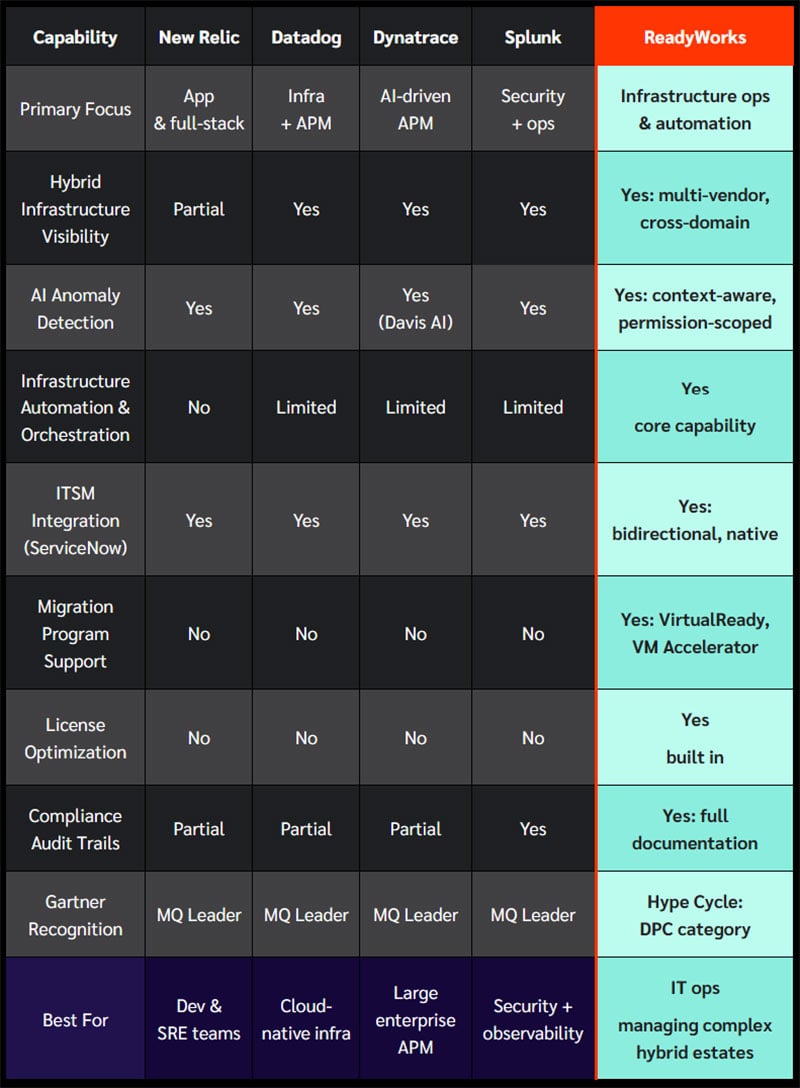
Sources: TechTarget (techtarget.com/searchitoperations/tip/Top-observability-tools), Gartner Peer Insights (gartner.com/reviews/market/observability-platforms), ReadyWorks platform capabilities (readyworks.com).
The Bottom Line
When evaluating observability platforms for complex infrastructure management, three questions separate platforms that move the needle from those that add noise:
- Does it automate remediation, or just detect problems?
- Does it produce the governance and compliance documentation regulated environments require?
- Does it integrate automation and orchestration (not just visibility) across your full hybrid estate?
ReadyWorks is built to answer yes to all three. Explore the ReadyWorks platform for a full overview, or schedule a demo to see how it works across your specific infrastructure estate.