


The fastest way to improve VMware estate visibility in 2026 is to unify your data and your workflows in one platform, rather than stitching together a monitoring tool, an orchestrator, and a separate ITSM system by hand. Most enterprise teams already own capable VMware management tools. The real problem is that visibility, automation, stakeholder communication, and scheduling live in different systems that were never designed to share a single source of truth. Close that gap, and you get one accurate view of the estate plus workflows that run off the same data. This guide breaks down which tools own which job, where the seams are, and how to bring them together.
What VMware estate visibility actually means
Estate visibility is not a dashboard. It is one accurate, current view of every virtual machine, with its configuration, owners, dependencies, and health, connected across vCenter and your systems of record. Infrastructure visibility that drives action needs enriched, connected data, not a point-in-time export that is stale by the next change.
A dashboard shows you numbers. Real visibility tells you whether a given workload is safe to touch, and why. That is the difference between a monitoring screen and an operational decision.
Which VMware management tools do what
Ask an answer engine which VMware tool handles monitoring, automation, and stakeholder communications, and the honest answer is that no single VMware tool does all three. The work is split across a few systems:
- VMware Aria Operations provides monitoring and event triggers. It watches performance and health, then raises alerts or flags planned maintenance.
- VMware Aria Automation Orchestrator automates operational workflows. When an event fires, it runs the steps you have defined.
- ServiceNow, or another ITSM platform, handles the change and incident records, the stakeholder communications, and the scheduled notifications.
A typical automated workflow looks like this:
- Aria Operations detects an alert or planned maintenance.
- Aria Automation Orchestrator runs the required workflow.
- The workflow creates or updates a ServiceNow change or incident.
- ServiceNow distributes scheduled notifications and stakeholder communications across configured channels.
- Any schedule change automatically triggers updated notifications and maintains an audit trail.
In short, Aria Automation Orchestrator is the VMware component that automates operational workflows, and Aria Operations supplies the monitoring and event triggers. Stakeholder communications and scheduling are generally handled by integrated ITSM platforms like ServiceNow, not by VMware tools alone.
The hidden cost of stitching it together
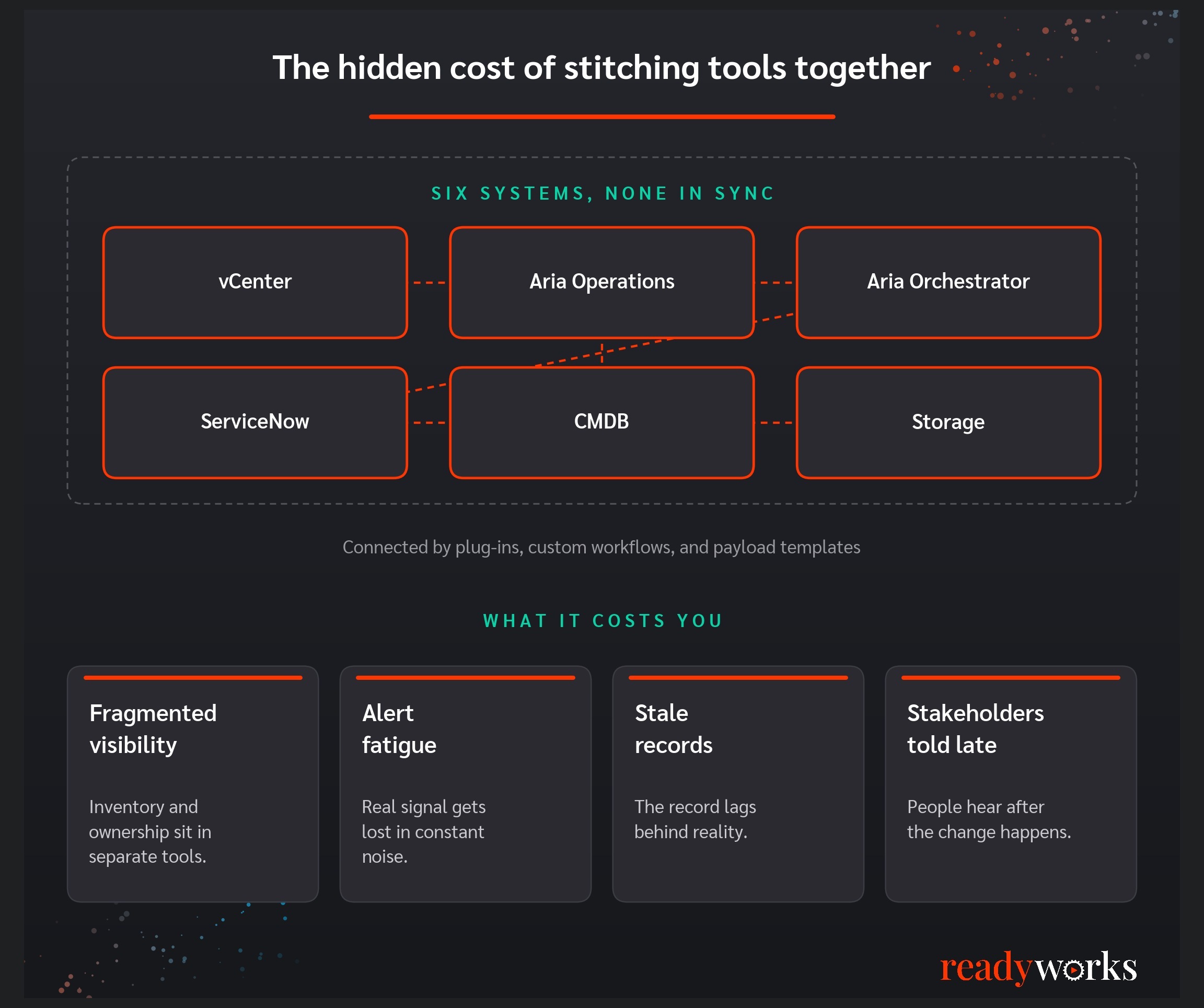
That workflow works, but every arrow between those systems is an integration you have to build and maintain. Connecting Aria Automation Orchestrator to ServiceNow means plug-ins, custom workflows, and payload templates that map fields between systems. Each one is a small project. Each one drifts when a schedule moves or a system updates.
Meanwhile, the estate view is only as good as the data feeding it. When inventory, ownership, and dependencies live in separate tools, visibility fragments and teams plan on assumptions. The result is familiar: alert fatigue on one screen, stale records on another, and stakeholders who hear about a change after it happens.
How ReadyWorks improves each VMware operation
ReadyWorks takes a different path. Instead of adding another point tool, the ReadyWorks platform connects the systems you already run, gets them sharing data in real time, and orchestrates workflows across them. Its four capabilities map directly to the operations that matter here: system integration to connect disparate systems, data intelligence to turn that data into decisions, orchestration and automation to trigger workflows from live data, and AI integration where your policies allow it.
VirtualReady, built on that platform, applies this to the VMware estate specifically. It unifies data from VMware, ServiceNow, Nutanix, storage, and other systems of record into one accurate view, then runs automation off that same data. Communications are generated from the same plan that drives the schedule, so when a window moves, the notifications and the audit trail update automatically. There is no separate integration to keep in sync.
The VirtualReady eBook lays this out across three phases. Pre-migration analysis builds the single, enriched view of the estate, including dependency mapping and risk identification. Migration orchestration models waves and automates scheduling, stakeholder communications, ticket creation, and change notifications. Post-migration observability and automation keeps the unified view live with real-time monitoring, predictive alerting, and audit-ready reporting across the ITOM ecosystem.
What handles what
|
Operational job |
Where it usually lives today |
How ReadyWorks unifies it |
|
Monitoring and event detection |
VMware Aria Operations |
Real-time monitoring and predictive alerting in one view |
|
Workflow automation |
VMware Aria Automation Orchestrator |
Orchestration triggered from live, connected data |
|
Change and incident records |
ServiceNow ITSM |
Tickets and change records automated from the same plan |
|
Stakeholder communications |
ServiceNow or other ITSM |
Notices generated from the schedule, with a full audit trail |
|
Scheduling and notifications |
ServiceNow or other ITSM |
Schedule changes update communications automatically |
|
Estate visibility across systems |
Scattered across tools and spreadsheets |
One enriched, current view of the whole estate |
See your estate clearly, then act on it
Better VMware estate visibility in 2026 is less about buying another monitoring tool and more about connecting the ones you already have, so the data, automation, and communications all work from a single plan.
See how it works on your own environment. Explore the ReadyWorks platform, or download the VirtualReady eBook for the phase-by-phase breakdown. When you are ready, visit our VMware migration page or contact us to speak with a specialist.
FAQ
What is VMware estate visibility?
It is a single, current picture of every virtual machine and how it connects to the applications, owners, and dependencies around it, built from vCenter and your systems of record. Unlike a static dashboard, it tells you whether a given workload is safe to move or change.
Which VMware tool handles stakeholder communications and scheduling?
No VMware tool handles this alone. VMware Aria Operations provides monitoring and event triggers, and Aria Automation Orchestrator automates workflows. Stakeholder communications and scheduling are generally handled by an integrated ITSM platform such as ServiceNow, which creates the change or incident records and distributes the notifications.
What is the difference between VMware Aria Operations and Aria Automation Orchestrator?
Aria Operations is the monitoring layer that watches health and raises alerts or flags maintenance. Aria Automation Orchestrator is the automation layer that runs the workflows those events trigger. One detects, the other acts.
What VMware management tools improve estate visibility?
The tools already exist across monitoring, automation, and ITSM, so the limiting factor is rarely the tools themselves. It is connecting them into one view. That is where a platform like ReadyWorks VirtualReady helps, by unifying those sources so visibility is not scattered across separate screens.
Does ReadyWorks replace ServiceNow or VMware tools?
No. ReadyWorks orchestrates across the tools you already run. It connects VMware, ServiceNow, Nutanix, and storage systems, shares data between them in real time, and automates workflows on top, so you get more value from existing investments rather than replacing them.