

We've watched this market long enough to see the same pattern repeat. A team gets good visibility into its hybrid estate. Then it hits a wall the moment it tries to act on what it sees. This is our view on why hybrid IT observability automation needs security and governance built in from the start. It's also how our own thinking on it has changed as the platform has evolved.
Where we started, and what we got wrong at first
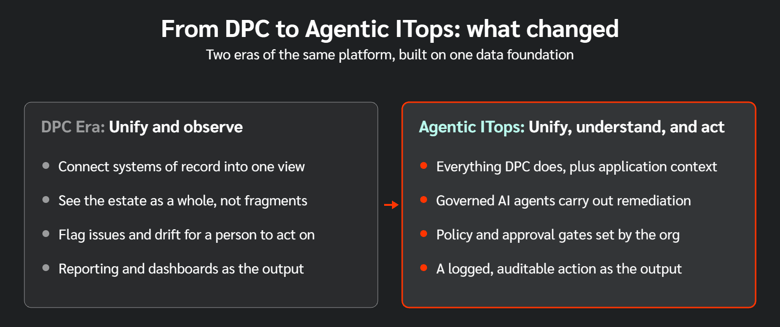
ReadyWorks built its name on Digital Platform Conductor, or DPC, a category Gartner has recognized us under since 2022, citing us across 26 Sample Vendor reports in 10 Hype Cycles. DPC was about unifying data across the systems an enterprise already runs, so the estate could be observed and understood as one thing instead of a hundred disconnected views. That heritage still shapes how we build. We didn't arrive at governed automation by adding rules to a fast-moving tool. We arrived at it by adding action to a platform that had already spent years earning trust on data and visibility.
We built our earliest solutions on a simple bet. If a team could see its infrastructure clearly, it would manage it well. That bet was half right. Visibility matters. But it doesn't close the gap between knowing something is wrong and being allowed to fix it. Almost every enterprise we've worked with runs a hybrid estate. Stonebranch's 2026 survey of IT automation professionals found that 88% of organizations now operate hybrid IT environments that combine on-premises infrastructure with public and private cloud. That's not a transition state anymore. It's the operating environment. And it's one most observability tools were never built for.
The gap shows up in the numbers we hear from customers every quarter. SolarWinds' 2026 survey of more than 750 IT practitioners found that observability gaps across cloud and on-premises environments remain the top challenge IT teams report. Security concerns are one of the factors slowing progress. We've seen that combination up close. Teams can see a problem clearly, but they hesitate to let anything act on it automatically. Nobody can say for certain what a given automation is allowed to touch.
Why we stopped treating observability and security as separate problems
For a while, we treated infrastructure observability and enterprise security as adjacent workstreams that happened to share data. That didn't hold up. The cost of a slow response is real and well documented. IBM's 2025 Cost of a Data Breach Report puts the average global breach cost above $4.4 million. Containment time is a major driver of that figure. A remediation workflow that isn't governed is a liability whether or not it ever runs. A team that doesn't trust its guardrails will disable the automation the first time something looks off. A team that trusts the wrong guardrails is exposed the moment something actually is.
So we changed how we build. Policy-driven automation isn't a feature we added to observability. It's the reason observability is worth automating at all. Every remediation workflow we ship now carries the guardrails with it: what it's allowed to touch, who has to sign off, and what gets logged. That's a different platform than the one we started with, and it's a better one.
What governed remediation looks like in practice
Unified visibility across the hybrid estate. One view of on-premises and cloud infrastructure, built from the systems already in place rather than a new agent deployed everywhere. If the platform can't see the whole estate, it can't act on it safely.
Policy before action. Every automated remediation runs against a defined policy, not a best guess. The policy says what's allowed, not the individual running the playbook that day.
Approval where the risk is real. Routine, well-understood fixes run on their own. Anything with real blast radius holds for a person to approve, and that line is a decision the organization makes, not the vendor.
A record of what happened. Every remediation, automatic or approved, is logged with a chain of custody. When security or audit asks what changed and why, the answer is a query, not a reconstruction.
Questions IT leaders ask
How can enterprises secure automated remediation in a hybrid IT environment?
Security comes from the guardrails around the automation, not from avoiding automation altogether. Define policy up front for what a remediation is allowed to touch. Hold approval at the points with real risk. Log every action with a chain of custody so the response can be reviewed later. Done this way, automated remediation reduces the time an issue stays open, which is itself a security win. It doesn't expand what any single automated action is trusted to do on its own.
What is ReadyWorks Digital Platform Conductor, and how does it fit hybrid IT observability?
DPC is where we started, as the section above explains, and it's still the foundation under everything we build. Today we describe our platform as Agentic ITOps instead, because it now does more than conduct data. It attaches application context to what it sees. It puts governed AI agents to work on the remediation itself, within guardrails the organization sets. That's not a rebrand. It's the next stage of the same idea: DPC unified the view, and Agentic ITOps acts on it.
Where to start
If your team can already see problems across the hybrid estate but hesitates to let anything act on them automatically, that hesitation is usually correct, given the tools most teams have. It's also solvable. To see governed, policy-driven remediation running across a hybrid estate, contact ReadyWorks.